CueStrideTry it free

For speakers and presenters

Speaker timer for the stage's confidence monitor

Give the speaker a countdown they can read from the lectern, and tell them when to wrap up without walking on stage.

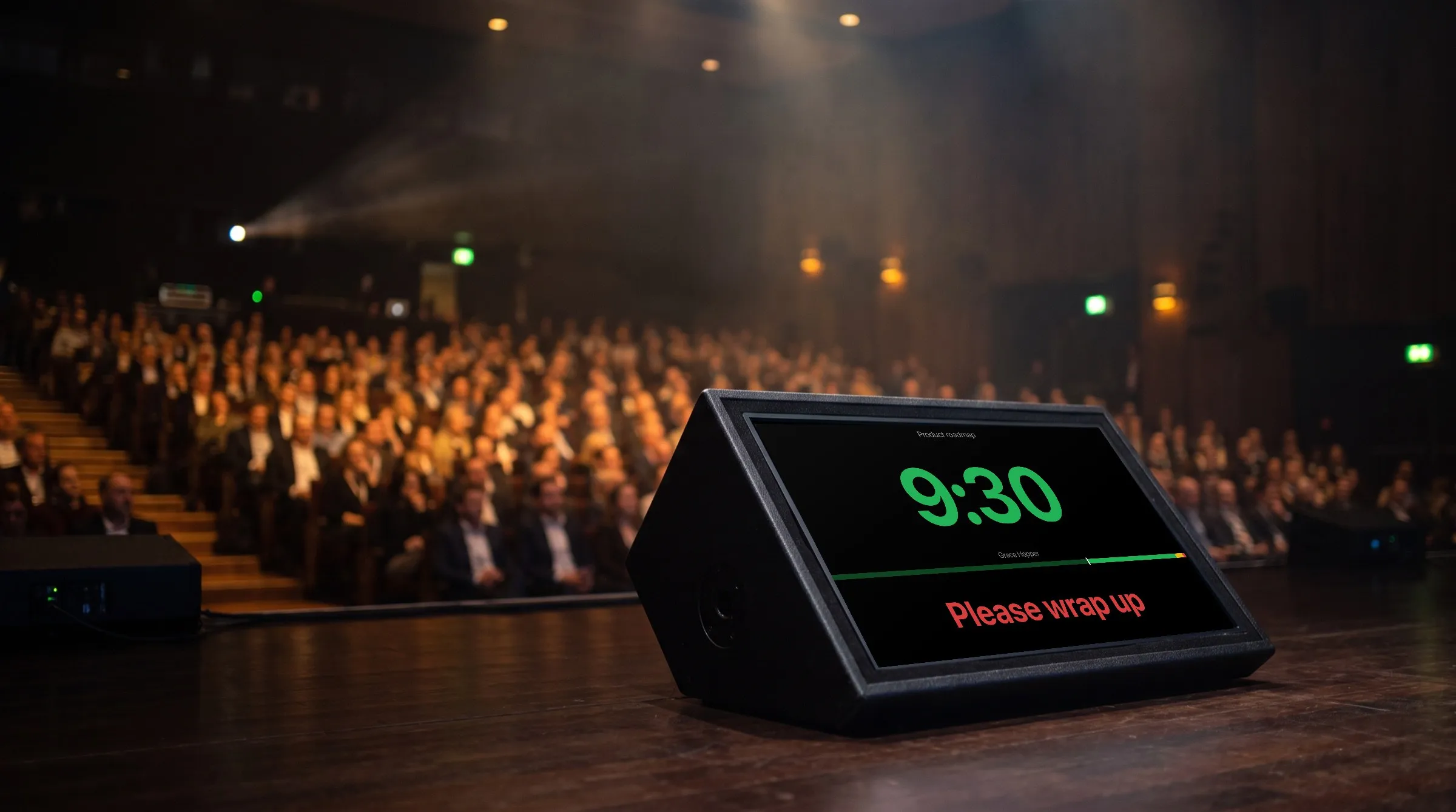
Illustration of a conference stage from the speaker's side: a floor monitor shows CueStride's real screen, 9:30 in green and Please wrap up in red, with the audience out of focus.
The room is an illustration; the screen is CueStride itself, captured from the app.

The problem

Why good speakers still run over

Time moves differently on stage. Adrenaline, a question from the front row, one more story: a talk that ran twenty minutes in rehearsal can run twenty-six in front of a crowd. Speakers who run over are rarely careless. They simply cannot see the time.

The usual fixes all ask something of the speaker. A watch means looking away from the audience. A laptop's clock is small, shows the time of day, and disappears when the slides go fullscreen. A timer in the slide software lives on the speaker's laptop, where nobody else can add a minute to it or tell them to wrap up. Cards held up in the front row need someone to hold them, and a speaker who looks at the right moment.

A speaker timer puts the time left where the speaker already looks, in digits big enough to read from the stage and colours that need no reading at all. And it gives the person running the show a quiet way to say more.

The story

A talk, from the speaker's side

What the speaker sees on the confidence monitor, from the walk-on to the handover.

  1. Walk-on

    Their title, their name, their time

    Before the host presses Start, the confidence monitor shows the talk's title, the speaker's name, and the full length, 20:00, standing still. The speaker knows the clock is theirs before they say a word.

  2. Start

    The clock starts

    The host presses Space as the speaker says good morning. The digits count down in green across the whole width of the screen, and the bar beneath them shows the slot in green, yellow, and red, with a marker moving along it.

  3. 8 minutes in

    A nudge the other way

    The speaker is racing through the slides. The host sends You have time in green, the speaker takes a breath, and the talk settles. Messages are for more than stopping people.

  4. 19 minutes in

    Yellow, then red

    At one minute left the digits turn yellow, and at fifteen seconds red, which are the defaults and can change for every talk. If the host gave these moments a chime or a flash, every screen with its sound allowed plays the chime, and the digits blink as many times as set.

  5. 20 minutes in

    Over, and they know by how much

    The speaker is on the last slide and past zero. The clock keeps counting in red with a minus sign, so -0:40 says exactly how far over they are. The host sends Please wrap up in red and flashes it three times.

  6. Questions

    Time for the audience

    The host moves to the next timer, Questions, set to count up with the time of day beneath it, and starts it. The moderator sees how long questions have run and how close the break is.

  7. Handover

    The next name on the screen

    Next cues the following talk. Its title, the next speaker's name, and its full length appear, waiting for its own start, while the first speaker is still leaving the stage.

What it does

What makes a good speaker timer

Readable from the lectern

The digits fill the width of the screen, whatever its size, with the talk's title above them and the speaker's name below. Minutes and seconds only, until a talk is an hour or longer, so there is nothing to decode.

Colour before numbers

Green, yellow, red: a speaker reads the colour from the corner of their eye before they read a digit. The bar under the digits shows the same colours along the whole slot, with a marker at the current moment.

Messages without a word

Prepared messages in white, green, or red, bold or upper case, shown under the timer, filling the screen, or flashing to catch the eye. One shows at a time, and it stays until you hide it, so a speaker who looks away does not miss it.

Time you can give and take

Plus and minus add or take away a minute, and other amounts, such as five minutes or 2:30, are a tap away. The clock never restarts, and the bar rescales to the new total.

The right clock for each part

Count down for the talk, count up for the questions, or show the time of day, with the countdown and the clock together when the speaker needs both. The time of day follows the room's time zone and a 12 or 24 hour clock.

Still counting when the Wi-Fi drops

A monitor that loses its connection keeps counting from what it last knew and shows a small indicator in its corner. It catches up within seconds of reconnecting, including anything the host changed in the meantime.

An example

An example rundown: a morning of talks

A keynote with questions, two talks, and three lightning talks, with warnings that grow with the length of the talk.

TimeSegmentLed byLengthStartsYellow · red
09:15DoorsCountdown with the time of dayHostUntil 09:30ScheduledNone
09:30WelcomeHost5 minLinkedYellow at 1:00Red at 0:15
09:35KeynoteKeynote speaker40 minManualYellow at 5:00Red at 1:00
10:15Keynote questionsCounts up, with the time of dayModerator10 minManualNone
10:25Talk: the product roadmapSecond speaker20 minManualYellow at 3:00Red at 1:00
10:45Talk: a customer storyThird speaker20 minManualYellow at 3:00Red at 1:00
11:05Lightning talk 1Speaker5 minManualYellow at 1:00Red at 0:15
11:10Lightning talk 2Speaker5 minLinkedYellow at 1:00Red at 0:15
11:15Lightning talk 3Speaker5 minLinkedYellow at 1:00Red at 0:15
11:20CoffeeShows the time of dayEveryone20 minLinkedNone

The welcome is linked to the doors countdown, so it starts at half past nine on the dot. The keynote and the talks are manual, so a talk that runs over shows its overtime in red until the host moves on. The lightning talks and the coffee break are linked, so the fast part of the morning runs itself.

10 timers: more than the free plan's 3 per room, so this rundown needs Pro or above, which holds 50 per room.

Set it up

How to set up a speaker timer

  1. 1

    Create a room

    One click, with no account. The room starts with a ten-minute timer: rename it for the first talk and set its length.

  2. 2

    Add a timer for each talk

    Give each its title, the speaker's name, its length, and its yellow and red times. Notes for the host stay on the controller and never reach the screen.

  3. 3

    Put the viewer on the confidence monitor

    Open the viewer link on any screen with a current browser, such as a laptop over HDMI, a tablet on the lectern, or a TV's own browser, and go fullscreen. Tap it once if you want its chimes.

  4. 4

    Write your messages before doors

    Four or five are enough: You have time, Five minutes, Please wrap up, and Thank you. During the talk, each is one click.

  5. 5

    Run it from the keyboard or your phone

    Space starts and stops, N moves to the next talk, P goes back, and plus and minus give or take a minute. On a phone, each is one tap.

Start with step one

A room in one click, no account needed.

Tips

Tips for keeping speakers on time

  • Put the monitor where the speaker already looks

    On the floor at the front of the stage, angled up towards the lectern, or on a stand at the back of the room above the audience's heads. Stand where the speaker will stand and read it before doors.

  • Brief the speaker in thirty seconds

    Before they walk on, show them the screen: here is your time, yellow means start landing, red means finish your sentence, and a message from me is worth reading.

  • Agree what zero means

    Is zero a hard stop, or can the speaker finish their point? Decide it with the speaker and the host before the talk, so the red minus sign means the same thing to both.

  • Send fewer messages

    A speaker who gets five messages stops reading them. Send one when it changes what the speaker should do, and keep flashing for the moment that really matters.

  • Give questions a timer of their own

    Questions overrun faster than talks do. A separate timer, counting up or down, stops them from quietly eating the next speaker's slot.

  • Keep chimes away from the microphones

    A chime helps a speaker who is looking at the audience, but only from a screen the microphones cannot hear. Timers are silent unless you add a chime, so leave it that way on stage.

Plans

Which plan a speaker timer needs

A single talk, or a session of up to 3, fits the free plan: 3 timers per room and 3 connections, your controller and two confidence monitors. No card, no time limit, and nothing held back from the timer or the messages.

A full morning of talks needs Pro: 50 timers per room and 5 screens per room, and more in packs of 5 up to 50. Your logo on the screens is Pro and up. For a one-off event, Pro comes as a pass.

For one talk on one screen, the free timers on this site run in your browser with no room at all:

Compare every plan

FAQ

Questions, answered.

Can the speaker see the time of day as well?

Yes. A timer can show the countdown with the time of day beneath it, or the time of day on its own, in the room's time zone and a 12 or 24 hour clock.

What does the speaker see when they run over?

The clock keeps counting past zero in red with a minus sign, so -1:20 means eighty seconds over. You can flash the digits, send a message, or both.

Can I mirror the timer for a teleprompter?

Yes. A screen flips horizontally, vertically, or both, from its own toolbar or from your controller, and remembers its flip. A viewer link can carry the flip, so a prompter opens mirrored.

Does the confidence monitor need an app?

No. Any screen with a current browser opens the viewer link. It never signs in, installs nothing, and asks the device to stay awake where the browser allows it.

Can the timer make a sound?

Yes, if you want it to. Each timer can chime at its start, at yellow, at red, and at zero, with a soft tone, a bell, or an alarm. Browsers only play sound after a tap, so each screen asks for one tap, once.

How do I time the questions after a talk?

Add a timer for them after the talk, counting down to keep them short or up to see how long they run. Or add minutes to the talk itself: the clock carries on without restarting.

Can a speaker run their own timer?

Yes. The controller runs on a phone as well as a laptop, so a speaker without a host can keep it on the lectern and press Space, or tap Start, when they begin.

Is there a free speaker timer?

Yes. A room on the free plan runs a full speaker timer with 3 timers, the colours, and the messages, and you can try one without an account. For a single countdown on one screen, the free timers on this site need no room at all.

Your next show, on time.

A room in one click, no account needed. Put its link on a screen and run the show; sign up free when you want to keep it.

Try it now, free